

As part of efforts to address the metering gaps in the power sector, the Federation Account Allocation Committee (FAAC), has secured N7000BN, under the Presidential Metering Initiative (PMI) to deploy 1.1 million meters by the end of 2025, and 2 million meters annually for the next five years.
This is to complement the 3.2 million meters being procured through the World Bank’s DISREP programme.
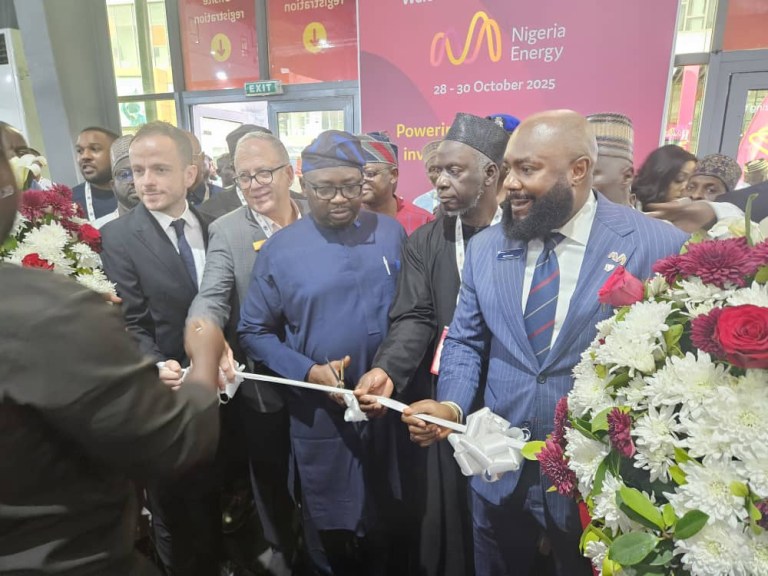
The Minister of Power, Chief Adebayo Adelabu, made this known while delivering his address at the Nigeria Energy Forum 2025, held at the Landmark Event Centre in Lagos, where policymakers, investors, and industry experts gathered to deliberate on the future of Nigeria’s energy landscape
He outlined ₦4tn bond, ₦700bn metering plan, and $2bn renewable investments to boost access, efficiency, and sustainability
The minister described the move as a comprehensive reforms aimed at repositioning Nigeria’s power sector for sustainability, efficiency, and growth through strategic investments, innovation, and public-private partnerships.
Chief Adelabu commended Informa Markets for sustaining the annual forum as a credible platform for connecting global investors, exploring innovative technologies, and fostering strategic collaborations in the power sector.
According to him, the forum’s theme, “Powering Nigeria through Investment, Innovation, and Partnership,” reflects the Federal Government’s renewed commitment to building a resilient, inclusive, and sustainable energy future. He noted that the vision aligns with President Bola Ahmed Tinubu’s Renewed Hope Agenda, which prioritises economic revitalisation through enterprise, innovation, and shared prosperity.
Adelabu highlighted the Electricity Act 2023 as a major milestone in the nation’s power sector reform, describing it as a “game changer” that devolves regulatory powers to subnational governments and promotes competition and private sector participation. He stated that since the enactment of the Act, 15 states have received regulatory autonomy to establish subnational electricity markets, with one already operational. The Federal Government, he said, is working actively with these states to ensure strong alignment between the wholesale and retail markets.
He further disclosed that the Integrated National Electricity Policy, approved by the Federal Executive Council in February, is being finalised with a strategic implementation plan to harmonise existing policies and provide a coherent roadmap for sustainable growth.
He said the government’s tariff reforms have led to improved revenue collection, enhanced supply reliability, and increased investor confidence. “Industry revenue rose by 70 per cent to ₦1.7 trillion in 2024 compared to the previous year, and is projected to exceed ₦2 trillion in 2025,” Adelabu stated.
To stabilise the market, he disclosed that President Tinubu has approved a ₦4 trillion bond to clear verified debts owed to generation companies (GenCos) and gas suppliers. He also revealed that a targeted subsidy framework is being developed to protect vulnerable households while ensuring the long-term commercial viability of the industry. Adelabu added that the Federal Government plans to introduce a minimum capital adequacy requirement for distribution companies (DisCos) during their license renewal process, to strengthen liquidity and improve service delivery.
The Minister explained that the Federal Government has launched targeted national programmes to accelerate grid expansion and modernisation under the Presidential Power Initiative (PPI). He said Phase Zero of the PPI has already delivered over 700MW of additional transmission capacity, while Phase One — expected to add 7,000MW — is underway, with contracts signed with Siemens Energy, CMEC, Elswedy Electric, and Power China.
Adelabu also announced the successful integration of the 700MW Zungeru Hydropower Plant into the national grid, which helped raise average generation capacity to 5,300MW in 2024, up from 4,200MW in 2023. He confirmed that the Federal Government has unbundled the Transmission Company of Nigeria (TCN) into the Nigerian Independent System Operator (NISO) and the Transmission Service Provider (TSP) — a reform he described as “long overdue and vital to grid efficiency.”
Adelabu revealed that the Federal Government is mobilising over $2 billion through key facilities — including the $750 million World Bank DARES programme, the $500 million NSIA RIPLE platform, and the $190 million JICA fund — to drive renewable energy expansion and increase power access across rural and underserved communities.
He said the Ministry recently upgraded training infrastructure at the National Power Training Institute of Nigeria (NAPTIN), with new workshops, simulation tools, and hostel facilities to enhance capacity building. “At the 2025 Nigerian Renewable Energy Innovation Forum, we signed agreements that will bring on stream nearly 4 gigawatts per annum of solar manufacturing capacity — equivalent to 80 per cent of our current national generation capacity,” Adelabu announced.
He further disclosed that Nigeria has commenced export of locally produced solar panels to Ghana, signalling the country’s readiness to serve regional power markets.
The Minister reaffirmed that Nigeria’s power sector is now more open and investment-ready than ever before, calling on private developers and financiers to take advantage of emerging opportunities, particularly in transmission infrastructure.
“With over 10 gigawatts of stranded generation capacity, we are open to strategic partnerships to mobilise the investments required to unlock this potential,” he stated.
He urged stakeholders to think boldly, collaborate strategically, and invest purposefully, adding that the opportunities before Nigeria are immense — not just to bridge the power gap but to ignite industrial growth, technological innovation, and shared prosperity.
“Together, through sustained investment, forward-thinking innovation, and strong partnerships, we can power Nigeria’s journey toward a brighter, more resilient, and energy-secure future,” Chief Adelabu concluded.