

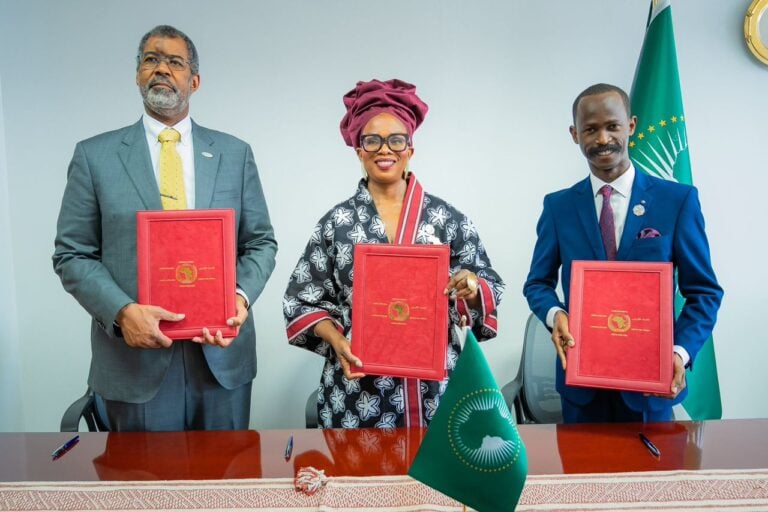
The African Union (AU), the African Commission on Nuclear Energy (AFCONE) and the OECD Nuclear Energy Agency (NEA) have signed a memorandum of understanding (MoU) to advance the peaceful application of nuclear science and technology for Africa’s socio-economic development.
The NEA is an intergovernmental agency under the Organisation for Economic Cooperation and Development (OECD) that facilitates cooperation among countries with advanced nuclear technology.
The MoU was signed on the margins of the 39th AU summit in Addis Ababa, Ethiopia on Friday.
It establishes a structured framework for cooperation on capacity building, regulatory strengthening, research and innovation, and the mobilisation of technical and financial resources in support of Africa’s energy transition and industrialisation agenda.
The pact will also help ensure coordinated exchanges on the African continent and foster closer relationships between organisations in Africa and those within NEA member countries, some of which include the US, UK, France, Japan, and Germany.
The MoU will remain valid for an initial period of three years, with the possibility of renewal subject to review.
Speaking at the signing ceremony, Lerato Mataboge, AU commissioner for infrastructure and energy, described the partnership as a strategic step towards strengthening Africa’s energy sovereignty.
According to the AU, Africa supplies around 15 percent to 18 percent of the world’s mined uranium, yet contributes less than one percent to global nuclear electricity generation.
Uranium is the main natural resource used for nuclear energy.
South Africa is the only African country currently utilising nuclear energy, which accounts for about five percent of its electricity generation, with a total installed capacity of 1,854 gw.
William Magwood, IV, NEA director-general, said the partnership would create a vital platform for promoting informed, fact-based decision making and shared progress as other African countries explore the development of nuclear energy.
“The challenges these countries face are similar to those experienced by many NEA members, and by working together we can advance economic development and skills expansion across the African continent,” Magwood said.
Egypt is currently in the process of building a nuclear power plant with an expected completion date in 2031.
Nigeria, Algeria, Ethiopia, Ghana, Kenya, and Morocco have also declared nuclear energy ambitions.
Nigeria has set 2030 as a timeline to achieve an eight percent nuclear energy contribution to its power generation portfolio.